


After Dark - Survival Tomb
SayGames Ltd
I spent time with After Dark - Survival Tomb as a compact role-playing game built around a simple promise: enter an ancient tomb, keep a torch alive, deal with monsters, and improve your chances of surviving the next encounter. That setup is easy to understand, but the experience is more interesting when you look at how it works for different players and different situations. It is not just a question of whether the adventure is entertaining; it is also about whether the screen remains readable, whether the controls feel manageable, and whether the game fits the way you actually play on a phone.
My first impression was that this is designed for short, repeatable sessions rather than a huge, story-heavy role-playing commitment. The free entry point makes it easy to try, while optional purchases ranging from $1.99 to $59.99 per item create a clear reason to pay attention to progression and spending habits. I would recommend giving it a fair trial if you enjoy light survival adventures, but I would not present it as a substitute for a deep console-style RPG. Its appeal is in the quick loop of exploring, fighting, crafting, and trying to go a little farther.
How the tomb adventure feels to use
Readable goals and straightforward navigation
The strongest part of the opening experience is the clarity of the basic objective. A torch, hostile creatures, equipment, and survival give the game an understandable shape without requiring a long explanation. I never felt that I needed to study a complicated fantasy rulebook before making progress. That matters for players who prefer games that communicate through immediate actions instead of dense menus and lengthy tutorials.
The ancient-tomb setting also helps navigation feel purposeful. Moving through a dangerous place, checking what can help you survive, and deciding when to improve your gear creates a natural rhythm. Even when the individual actions are familiar, the setting gives them context. I was not simply collecting materials because a progress bar told me to; I was preparing for the next threat in a place where light and equipment matter.
That simplicity can be especially helpful for someone new to role-playing games. Traditional alternatives often introduce several currencies, character screens, skill trees, quests, and equipment slots within minutes. Here, the survival premise gives beginners an easier mental model. You can think in practical terms: stay alive, handle monsters, and make better gear. Players who want a large world with extensive dialogue and many branching decisions may find this approach too narrow, but players who dislike administrative clutter will probably appreciate it.
Related News






A useful habit is to pause mentally before each improvement rather than spending resources as soon as they appear. In a game built around survival, the best-looking upgrade is not automatically the most useful one. I found it more sensible to consider whether a change would help with immediate danger, support a longer run, or simply make the next few minutes feel smoother. That small decision-making layer gives the crafting element more value than a purely automatic upgrade system.
Controls, visual attention, and different motor needs
On a touchscreen, the most important accessibility question is not whether the game looks attractive; it is whether the player can reliably understand and trigger the action needed at the moment of danger. My experience was strongest when I treated each encounter as a sequence of small decisions instead of rushing every input. That approach should suit players who prefer deliberate play, while people who need very large touch targets or have difficulty with quick repeated gestures may need to test the game carefully on their own device.
There is also a difference between physical difficulty and cognitive load. The tomb theme asks you to track several things at once: your immediate safety, the value of available materials, the condition of your equipment, and what might be waiting ahead. None of those ideas is unusual for a survival game, but they can become tiring during a longer session. I found shorter play periods more comfortable because they kept the planning loop clear instead of turning it into background mental noise.
Gallery
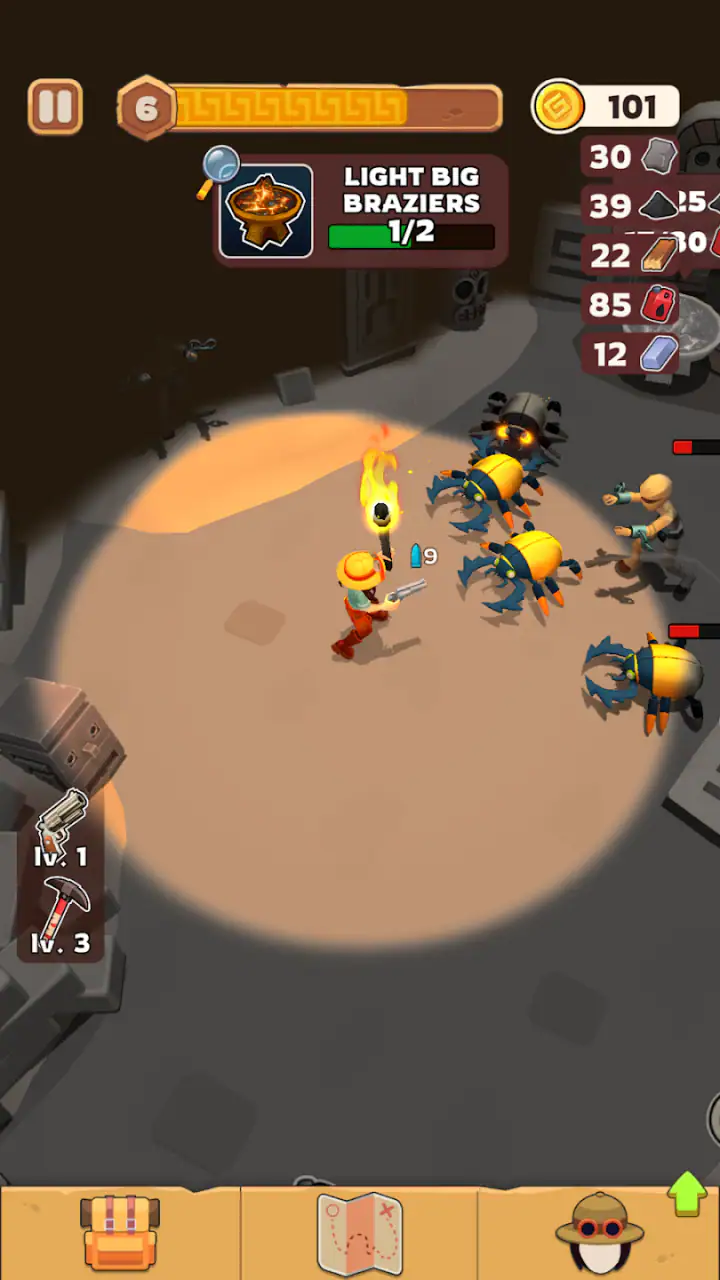
For players with visual sensitivity, the dark setting deserves attention before committing to long sessions. A torch-centered adventure naturally uses contrast between illuminated areas and shadowed surroundings. That can make the atmosphere effective, but it may also be less comfortable for someone who struggles with low-light scenes, bright effects against dark backgrounds, or frequent changes in visual focus. I would try the game at a moderate brightness level and avoid assuming that a dramatic dark presentation will suit every player.
Players who rely on audio cues should also treat the game as a visual-first experience unless they personally find its sound design sufficient. I would not base important decisions on sound alone. Watching the screen, reading the available information, and using the visible state of the adventure is the safer approach when timing matters. This is one of the places where a more traditional, menu-heavy role-playing game may be a better fit for someone who needs strong text-based guidance.
Playing in ordinary situations
The game makes the most sense for a phone routine with small gaps of free time. Imagine waiting for an appointment: you can enter the tomb, make a few decisions, fight, and work toward better equipment without needing to reserve an entire evening. That is where the compact structure works in its favor. It gives me a reason to return without demanding the same uninterrupted attention as a large open-world adventure.
That convenience has limits. A survival game is not ideal when you are walking, commuting in a distracting environment, or trying to divide your attention between the screen and another task. Even a simple encounter can become frustrating if you miss an important visual cue because you are in a noisy room or under poor lighting. I would play it while seated and focused, especially when attempting a more demanding stretch of the tomb.
It is also worth thinking about the device itself. The minimum operating system is Android 8.0, so the game is aimed at a reasonably broad range of Android phones, but an older compatible phone may still offer a less comfortable screen, slower response, or weaker battery life than a newer model. Compatibility is not the same thing as comfort. A player with a small display may find information harder to inspect, while someone using a larger phone or tablet could have an easier time keeping the action visible.
The free price makes the first decision simple: install it and see whether the control feel, visual style, and pace suit you. The more important decision comes later, when optional purchases become tempting. I recommend playing long enough to understand the normal progression before spending anything. That gives you a better sense of whether a purchase removes a genuine annoyance or merely accelerates a loop you already enjoy.
Where the experience is inclusive, and where it still asks for work
I like that the core fantasy is easy to grasp without requiring specialist knowledge. You do not need to know a complicated fictional universe to understand why a torch, useful equipment, and careful survival decisions matter. That makes the game approachable for casual players, younger players within its Everyone content rating, and people who usually avoid role-playing games because they expect too much reading or preparation.
The developer, SayGames Ltd, has also chosen a format that naturally supports brief experimentation. You can try the game without paying, learn whether its survival loop feels satisfying, and decide for yourself whether it deserves a place in your regular rotation. For a friend asking me whether to download it, that is a meaningful advantage: the barrier to sampling is low, even though the optional purchase range means I would still keep spending under control.
However, approachability should not be confused with universal ease. A dark visual environment, touchscreen timing, and the need to monitor several survival-related choices can create barriers for people with low vision, motor limitations, attention difficulties, or fatigue. I would particularly hesitate to recommend it as a blind or low-vision-first choice, because the central experience depends heavily on seeing what is happening in the tomb. Someone who needs extensive text scaling, high-contrast options, remappable controls, or dependable alternative input should verify the personal fit before investing much time.
Another trade-off is the difference between a game that is easy to start and one that remains comfortable over repeated sessions. The former is where this title performs well. The latter depends on the player. If you enjoy repeating a compact loop and making small improvements, the structure can feel pleasantly focused. If you need constant novelty, a large narrative, or a wide range of play styles, the tomb may begin to feel restrictive sooner than a bigger role-playing game would.
Practical ways to get more from each session
My first practical tip is to separate exploration from spending. It is tempting to craft or improve gear immediately because the reward is visible, but holding resources briefly can reveal what kind of problem the next section is actually presenting. That makes the crafting system feel like preparation rather than decoration. It also reduces the chance of using valuable materials on an upgrade that does not address your current weakness.
My second tip is to use short sessions as a deliberate strategy, not merely because the game happens to be on a phone. Stopping after a successful improvement helps preserve attention and makes it easier to remember what you were trying to achieve next time. This is particularly useful for players who become overwhelmed when several objectives compete for attention. A small goal, such as preparing equipment before another attempt, is easier to manage than treating the whole tomb as one continuous challenge.
Third, I would adjust the surrounding conditions before judging the game. A dark adventure viewed outdoors in strong sunlight can be harder to read, while playing in a completely dark room may make bright visual elements uncomfortable. A stable seated position, a clean screen, and a brightness level that does not force you to squint can make a surprising difference. These are not changes to the game itself, but they directly affect whether its torch-and-shadow presentation feels atmospheric or tiring.
Finally, decide in advance how you will handle in-app purchases. Because the game is free and individual items can cost as much as $59.99, it is better to treat spending as a separate choice from enjoying the basic adventure. I would never recommend buying simply because a difficult encounter creates pressure. Play the normal loop first, identify the exact friction, and ask whether paying would improve your enjoyment or only shorten the time between rewards.
How it compares with familiar role-playing alternatives
Compared with a traditional turn-based role-playing game, this is more immediate and less concerned with a long story or party management. That makes it easier to pick up during a short break, but it also means there is less room for elaborate character planning and narrative investment. If your favorite part of the genre is building a team, reading dialogue, and making choices that reshape a campaign, another game will probably satisfy you more.
Compared with a large action RPG, the tomb format feels more contained. You are not entering a broad world filled with sightseeing, side quests, and extensive exploration. The benefit is focus: the survival loop is easier to understand and less likely to bury the player under unrelated tasks. The drawback is that players who want freedom of movement and a sense of a huge journey may see the compact design as limited.
Compared with an endless-runner-style mobile game, it offers more planning through equipment and crafting. You are not relying only on reflexes or chasing a high score. At the same time, it does not appear aimed at players who want a purely relaxing experience, because survival pressure and resource decisions remain central. I would choose it over a reflex-only game when I want a little preparation and progression, but I would choose a calmer puzzle game when I am tired or unable to concentrate.
Who should try it and who should skip it
I think this is a good match for someone who wants a free role-playing game with a clear survival theme, quick sessions, and a manageable path from fighting to crafting. It is also a reasonable choice for a casual player who has never committed to a large RPG and wants to see whether equipment decisions and monster encounters are enjoyable. The Everyone rating makes it broadly approachable from a content standpoint, although individual comfort with dark imagery and touchscreen play still matters.
I would be more cautious if you have visual access needs that make dark scenes difficult, if you require extensive control customization, or if you cannot comfortably respond to on-screen action. I would also skip it if your main goal is a deep story, multiplayer cooperation, expansive exploration, or a very generous free-to-play structure with no temptation to spend. Those are not flaws in the same sense as a broken feature; they are signs that the game is built around a narrower experience.
The current version is 1.10.0, and the game has reached over 100 thousand installs with a 4.4 average from around 5.8 thousand ratings. Those figures suggest that it has found an audience, but they do not replace personal testing. My own recommendation is to use the free download as a trial, play in a comfortable environment, and judge the game by how clearly you can read and control it rather than by the atmosphere alone.
My inclusive verdict is cautiously positive: this is an approachable tomb-survival RPG when you want short, focused sessions and a simple reason to keep improving your gear. Its biggest strengths are the clear premise, the low-cost entry, and the satisfying connection between surviving encounters and preparing for the next one. Its biggest weaknesses are the demands created by dark visuals, touchscreen interaction, attention management, and optional purchases that can become expensive.
I would recommend it to a friend who enjoys compact mobile adventures and is comfortable evaluating accessibility through personal play. I would not recommend it blindly to someone who needs strong alternative input, highly adjustable presentation, or a story-led RPG. For the right player, the torch-and-tomb setup creates a pleasantly focused challenge. For everyone else, the free starting point is useful precisely because it lets you find out where you stand before making a larger commitment.
FAQs for After Dark - Survival Tomb
What is After Dark - Survival Tomb about?
After Dark - Survival Tomb is a survival adventure game focused on exploring a dangerous tomb after nightfall. You must navigate dark corridors, search for useful resources, solve environmental challenges, and avoid or overcome threats. Progress depends on careful exploration, managing supplies, and learning how the tomb’s hazards work rather than simply rushing from one area to another.
Is After Dark - Survival Tomb suitable for beginners?
The game can be approachable for new players, but it still expects patience and observation. Its dark setting, limited resources, and survival-focused mechanics may feel challenging at first, especially when you are learning where to go and how to react to danger. Players who enjoy exploration, suspense, and trial-and-error gameplay should adapt quickly, while casual players may need time to understand its systems.
Does the game require an internet connection to play?
After Dark - Survival Tomb may offer a primarily single-player experience, but connection requirements can depend on the version installed and how the developer handles advertisements, updates, saved data, or optional services. Before downloading, check the current store listing and permissions for your device. If offline play is important to you, test the game in airplane mode after installation.
Are there advertisements or in-app purchases in After Dark - Survival Tomb?
The presence of advertising and optional purchases can vary between releases, regions, and updates. Some versions of mobile survival games use ads for monetization, while others may include purchases for convenience, additional content, or removing advertisements. Review the Google Play or App Store listing before installing, and remember that availability of specific payment options may differ by platform.
What devices are compatible with After Dark - Survival Tomb?
Compatibility depends on the operating system, device model, available storage, and the minimum software version specified by the developer. Because the game relies on dark visuals, exploration, and real-time gameplay, older phones may experience slower loading, reduced performance, or increased battery use. Check the official store page for the latest Android or iOS requirements before downloading.
Pros
- Atmospheric lighting creates a tense and memorable survival experience.
- Exploration rewards careful observation and attention to environmental details.
- The tomb setting offers a distinctive alternative to typical survival games.
- Short gameplay sessions make it suitable for playing on mobile devices.
- Resource management adds meaningful choices during dangerous encounters.
Cons
- Dark environments can make some areas difficult to navigate on small screens.
- Limited resources may feel punishing for players new to survival games.
- Repetitive exploration can reduce variety during longer play sessions.
- The tense atmosphere may not appeal to players seeking relaxed gameplay.
- Performance may vary on older phones
- especially in visually dense areas.


